At my first HYROX in Mumbai, we planned a 500-500 split on the SkiErg. We didn't follow it. We had no real plan for any station. I cramped on the rower and my partner had to finish it alone — after already carrying me through burpees. We finished in 1:37:23 and I walked away thinking: there has to be a smarter way to split these stations.
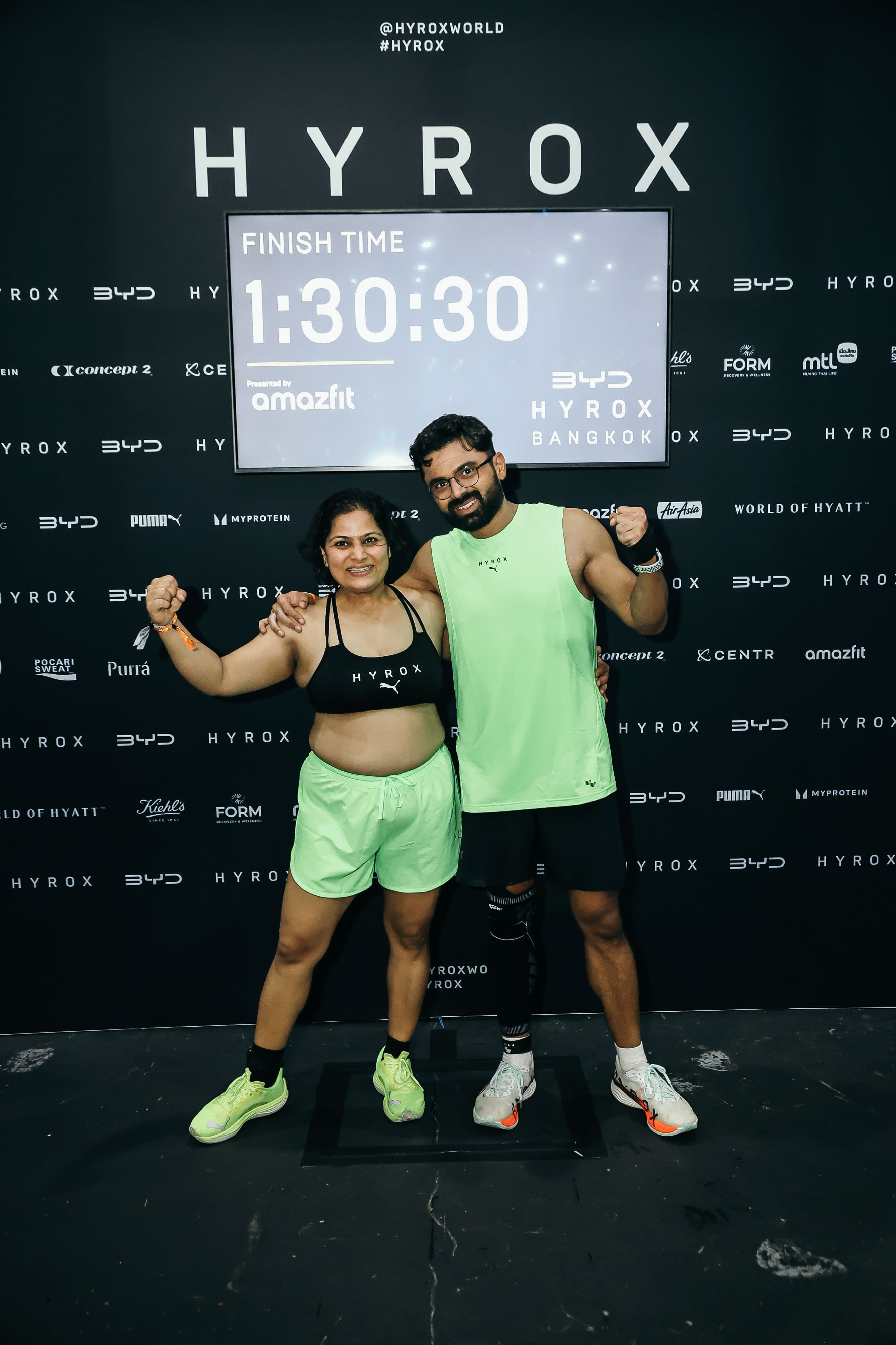
Three doubles races later — Mumbai Men's Doubles (1:37:23 with Tezuesh), Yoddha Mixed Doubles (1:03:25 with Shubhangini), and Bangkok Mixed Doubles (1:30:30 with Shubhangini) — I feel I have gotten better at our split strategies, at least for me. And I want to share that with all of you.
Oh and one more thing before we start — don't forget to pose for your photos! You have paid handsomely for them, so make sure you look good while dying inside :P
If this is your first time hearing about HYROX, start with our beginner guide and come back here when you're ready for doubles-specific strategy.
A quick note on Yoddha: it's a different race format — 7 stations instead of 8, different order, no SkiErg, and box jumps instead of burpee broad jumps. The rest of the stations are the same. I'll mention my Yoddha splits where the stations overlap.
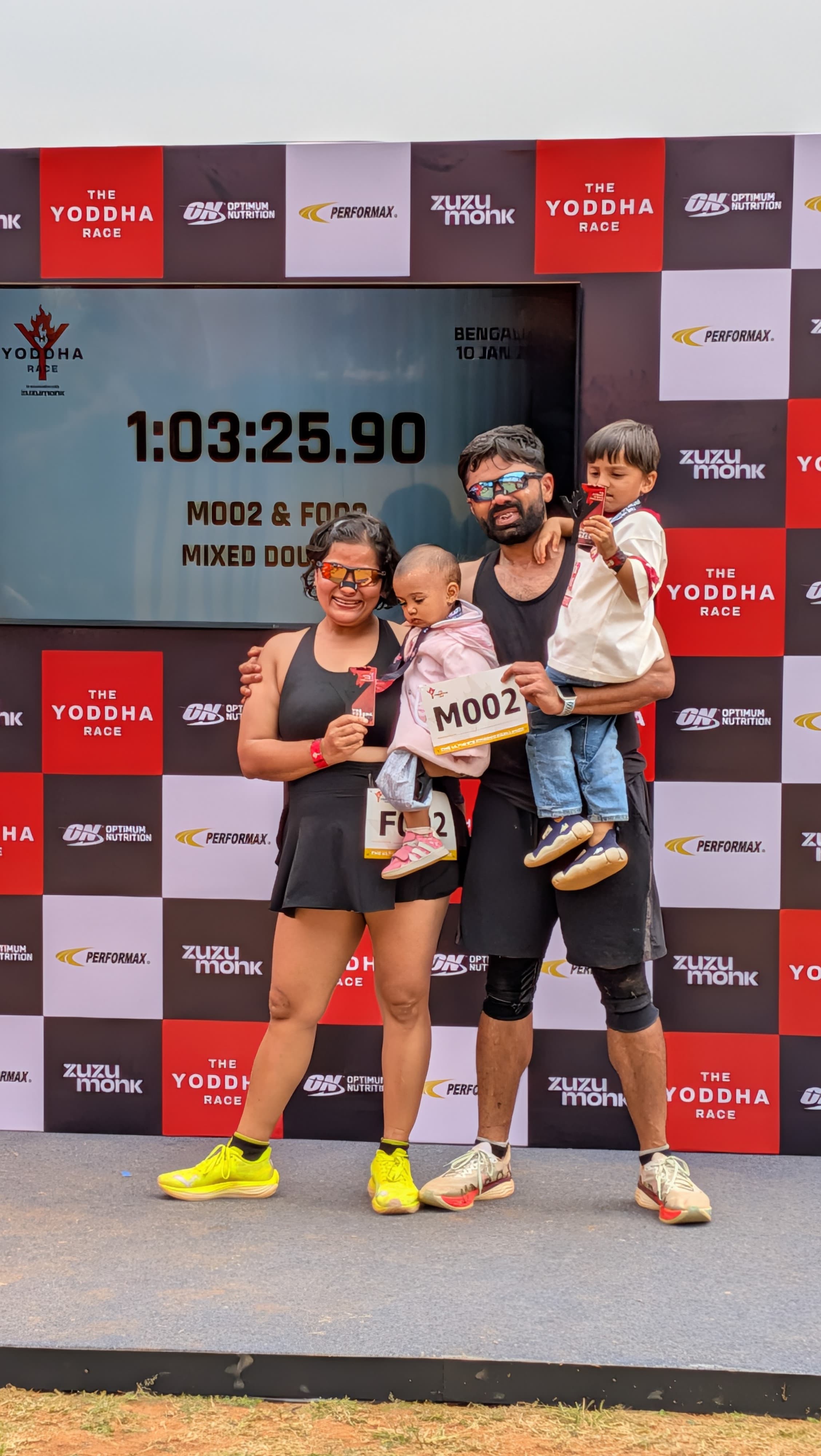 Naman, Shubhangini, and the kids at the Yoddha Mixed Doubles finish — 1:03:25
Splits might be slightly different in case of Doubles (Men or Women) and Mixed Doubles.
Running both partners have to do, but usually in most of the cases, specially in open category one runner is stronger than the other. And one might be more stronger than the other.
Most important advice I can give you is start your runs slower, don't let the start tunnel and other athletes pump you up! Start 10 seconds slower than your pace — check our pacing guide if you want to plan this properly! Race is won in the second half not the first. Because by the time you reach second half, you are cooked, and going from your willpower, so you need something in your tank!
If you already know about HYROX, in the Doubles category — whether Men's, Women's, or Mixed — both partners have to run the whole distance, all 8 laps of approximately 1 KM. And they can share all the stations, as they like. In most of them partners can switch any number of times as they like, but given it's a race against time and completion, there are few well followed strategies out there which most of the pro athletes, or people who have raced it more times than they can count.
One general rule! Stronger runners have to finish the station so that the other partner gets a breather before they start the next run. Same if stronger runner can also start the station that will help as well.
SkiErg
It's 1 KM in distance. And general tendency is to split 50-50. Which might work out well if both partners are stronger, but you can't really do much by saving 5-10 seconds here, but can gain a lot by preserving your HR from spiking through the roof on the very first station. At Mumbai, we planned 500-500 and didn't even follow it — ended up switching multiple times with no plan and finished in 4:18. At Bangkok we finished in 4:37.
So it would be better to do 125-125-125-125-125-125 or even 200-200-200-200-200 works. In 200 stronger runner can start and finish :P Which might not be the case in 125x6 so you might have to choose if stronger runner should start or finish. This will really help in maintaining the energy and yet finish in good time, since both of you will be fresh enough for short bursts. To know which technique works for you, try checking from your simulations — and that's where the HyCrew app will help you. What makes it good is because there is not much transition time here, it's very quick, get off, get on! Nothing much more to do! So you are not really wasting time here.
Sled Push
As for sled push, you are pushing 12.5 metres in 4 lengths, and depending on your category, you are either pushing 102 kgs or 152 kgs — check the weights page for full details. And I have seen people just push one lane and switch, so one partner pushes one full lane and switches. That is good, but in general what I would suggest is to do, in case of mixed or even just doubles, stronger athlete pushes 2/3 of the lane and the other pushes 1/3. You can even split it halfway if both are same.
What makes it a good strategy is because in sled push lactate builds real fast, and you might not realise it at that time but that lactate if not cleared properly will build and cause you to lose the rest of the race or even show up later. So you might have seen professionals or pro athletes push it half a lane, take 5-10 seconds to just take a short breather and then push it again. So they are planning really well for this. My splits across the three races: Mumbai 2:17, Yoddha 1:40, Bangkok 2:07.
Sled Pull
Sled pull, you are again pulling it 50 metres (4 lanes of 12.5 m each). So here stronger athlete pulls when the sled is far, and pulls it halfway, and switch! Run back to the other side, and do the same! The important thing to note is stronger athlete always starts the lane, and you should always run to the other side, not walk or stroll! Sled pull takes more time than sled push always! Because you are pulling, handling the rope, it's not similar to push, where you can continuously push and be done with it.
Here also, there are few techniques to do the pull. Strong people just use their hands, I have seen people do that. But the ideal strategy is to squat, pull the rope tightly — leave no tension or don't leave it loose, because of the elasticity of the rope it will be harder that way. So make sure rope is tight, and you are reaching as far as possible to hold the rope, and pull from your core, hinge! Not from your hand. Do not pull your hands, just stand up and keep walking backwards! And rope management is the other key factor here, learn this craft — it will be useful, otherwise either you or someone doing pull besides you might fall! Unless it's part of your strategy to make the fellow companion fall :P :P
Fun fact: my sled pull time was 4:18 across all three races — Mumbai 4:18, Yoddha 4:18, Bangkok 4:18. Exactly the same. Three different partners, three different race formats, same number on the clock every single time.
Burpee Broad Jumps
Now comes the burpee, 80 metres long! I really don't have anything to tell you here! :P People often suggest to go small and try to build a rhythm, but more often than not by the midway you will feel like just let me be and sleep here! But jokes apart, I have tried both, long jumps and short jumps. Long jump covers the distance more but increases your HR very quickly! But glad we are talking about doubles, do short bursts of 5-7 reps each, it's a lot easier and a lot more fun that way! Do long jumps, rest while your partner is doing their part! Gets covered easily and quickly! That's how you tackle the station dreaded by most if not all the athletes!
At Mumbai, Tezuesh did 70-80% of the burpees — we finished in 2:54. At Bangkok with Shubhangini we finished in 3:36. Yoddha has box jumps instead of burpee broad jumps — we finished those in 1:41.
Rowing
Rowing, again similar to SkiErg in nature but totally different as well. Here transition takes a lot of time, because you are sitting down, strapping in, holding the handle, and when getting out, loose the straps, put the handle back, and get up. So it takes a lot more time in transitions. So here there are few things I would suggest. If you are just changing once, stronger athlete finishes always! So partner starts, and rows for as long as they can — 300, 400 metres without killing them of course — and then the stronger partner finishes it off! Easy peasy! Or if you want to do it the other way, do 350-350-300 metres. So stronger athlete starts and finishes! Both work, but try not to split the same way as SkiErg though.
And hear it from a guy who has gotten cramps twice on this station: if you feel your legs are getting cooked, try pulling it from hands — doesn't take too much extra time to be honest and saves your legs for what's coming next — LUNGES and WALL BALLS!
I say this because at Mumbai, I was supposed to start the rowing. I grabbed the handle, pulled once, and my legs cramped for the first time in my life. I never knew a cramp could be this mean. Tezuesh had to do almost all the rowing after already carrying me through burpees — we finished in 5:22. At Yoddha, rowing is the first station so we had fresh legs and finished in 4:56. At Bangkok, 5:32.
Cramping on the rower? HyCrew tracks your station splits across simulations — so you can see exactly which earlier stations are cooking your legs before you even reach the rower.
Farmers Carry
Now coming to farmers carry, never found it difficult, you can finish it strong and quickly. This is a breather for your lower body to be honest! And if you can run, be my guest, hold the kettlebells and run! But I would advise you to finish unbroken or just put the bells down once and walk! This is a test of your grip! So hold the kettlebells from the front not middle, this lets your body weight help you in moving forward and makes the moving a bit easier. I don't really have much to say as of now! Oh I forgot I am writing for doubles, so in that case, again stronger athlete starts, carries it for as long as possible, puts it down, other partner takes it away to give breather for the athlete, and switch again. So all in all in two switches you can complete the whole 200 metres. Again for category-wise weights, please check our detailed page.
This was always our best station. At Mumbai we finished in 1:31 — ranked 20th on the day, even with my cramps. Yoddha 2:36. Bangkok 2:07.
Lunges
Now comes the toll on legs station! At least for me though! 100 metres! Try to do short lunges and in rhythm! Don't do continuous — lunge, stand, lunge. If you are someone like me you will thank me later! So what it does, it doesn't let lactate build up. And when you are standing for a split second, that is enough for doing it continuous and yet time effective. We feel doing continuous lunges after lunges without standing up is saving us time but not truly I feel. And it might save your legs to go all out on your last run! And DO remember you cannot put the sandbag on the ground — it's a 15-second penalty each time. So do practice this transition, really important. And transitions can vary depending on the heights of the partners. So do practice!
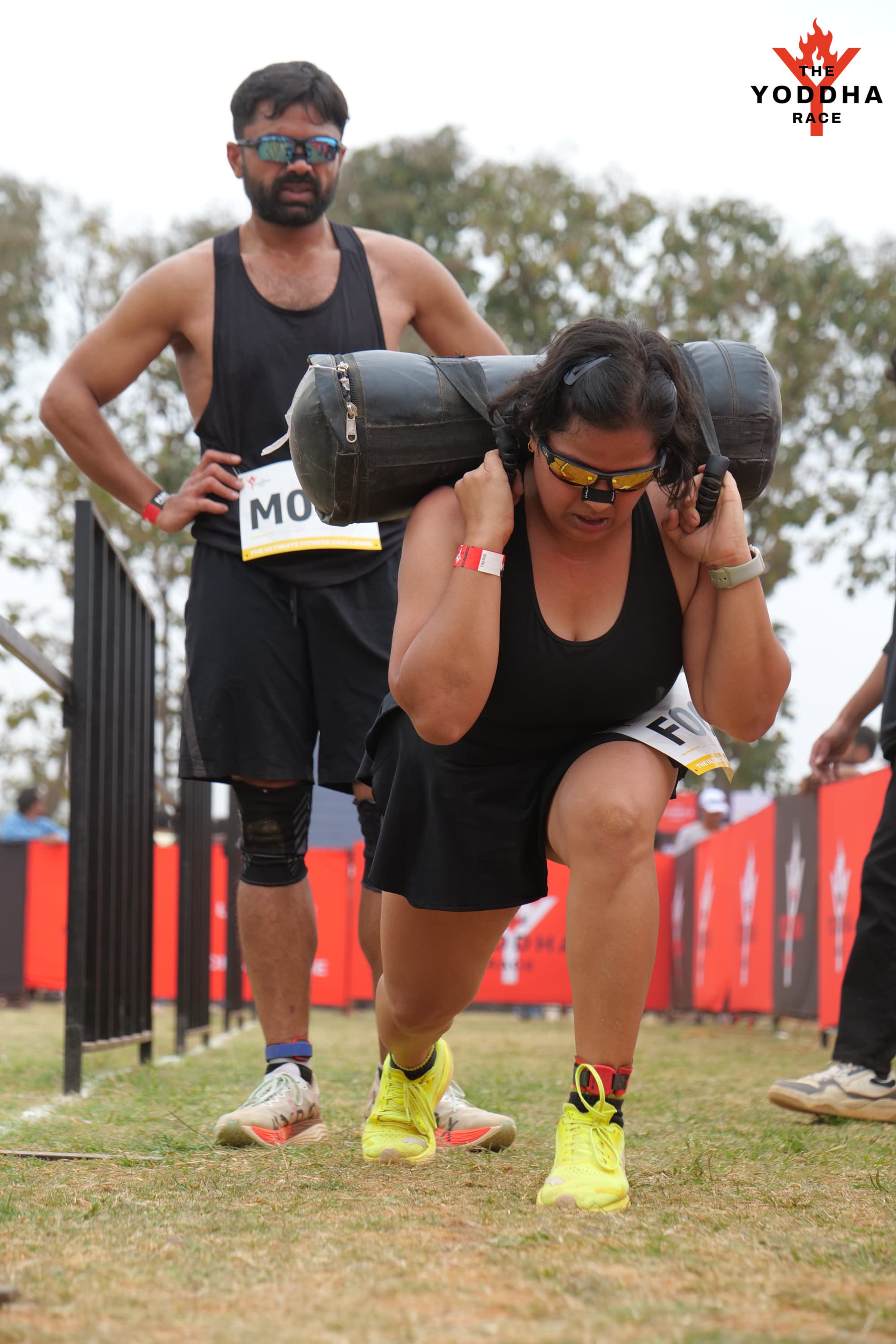 Shubhangini lunging with the sandbag at Yoddha Mixed Doubles while Naman waits for the handoff
My splits: Mumbai 4:40, Yoddha 4:50, Bangkok 4:58.
Wall Balls
And wall balls, there are a lot of theories out there on this. I mean it's the most dreaded station of all! I will list down a few. First thing is, people go all out on first set, like they do 20-30 on the first, and they are cooked, and remaining 70 feels like eternity. So do first sets as much as possible but don't go all out, stop few reps before. And then do 10 reps each until done, or decrease the number of reps each set but don't go all out again, unless you feel you can keep the same pace for the whole 100 reps of course! One strategy I read or saw somewhere, don't really know the source but I liked it very much is go 16-15-14-13-12-11-10-9 and done! Magical sequence! Practice with heavier ball on your simulations, but as you get closer to the race day, practice with the same weight as your category. Believe me this is important because you might throw the ball over the target, or miss it if you don't practice with the same weights!
My splits: Mumbai 4:36, Yoddha 3:41, Bangkok 4:52.
Want to know how your wall ball time stacks up? Check HYROX finish times for benchmarks, and track your own station splits with HyCrew on Apple Watch.
What 3 Races Taught Me
The biggest thing I learned across these three races is that doubles is not about individual station speed — it's about how you and your partner manage energy across the whole race. At Mumbai we had no plan, I blew up on the rower, and we lost time everywhere we didn't expect. By Bangkok, we had a plan for every station before we walked into the start tunnel.
The splits don't lie. Some of my station times barely changed across three races. But what changed was how I felt leaving each station and how much I had left for the runs in between. That's where the race is actually won.
If I could tell first-time doubles teams one thing: run your simulations together and figure out your splits before race day. Don't wing it like we did in Mumbai. Know who starts, who finishes, and how many switches you're doing at each station. Walk into the start tunnel with a plan.
That's exactly why we built HyCrew. It tracks every station split on your Apple Watch, simulation after simulation. You can see how splits are working for each partner, where time is leaking, and where you can improve — before you step into the start tunnel.
And remember what I said at the start — don't forget to pose for your photos! You have paid handsomely for them :P
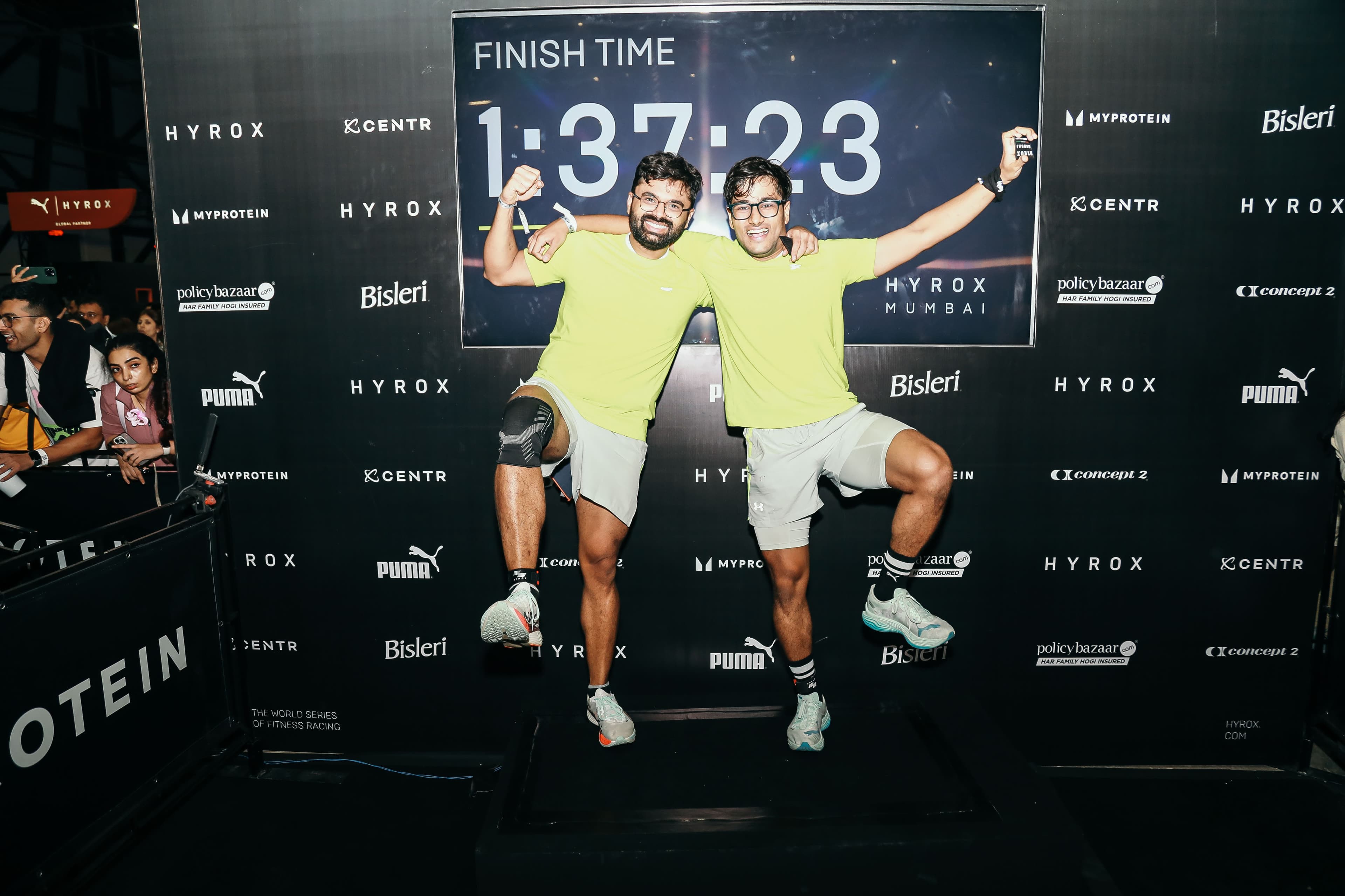 Naman and Tezuesh at the HYROX Mumbai 2025 Men's Doubles finish — 1:37:23, where it all started
Want to track your doubles splits? Download HyCrew — free on the App Store